
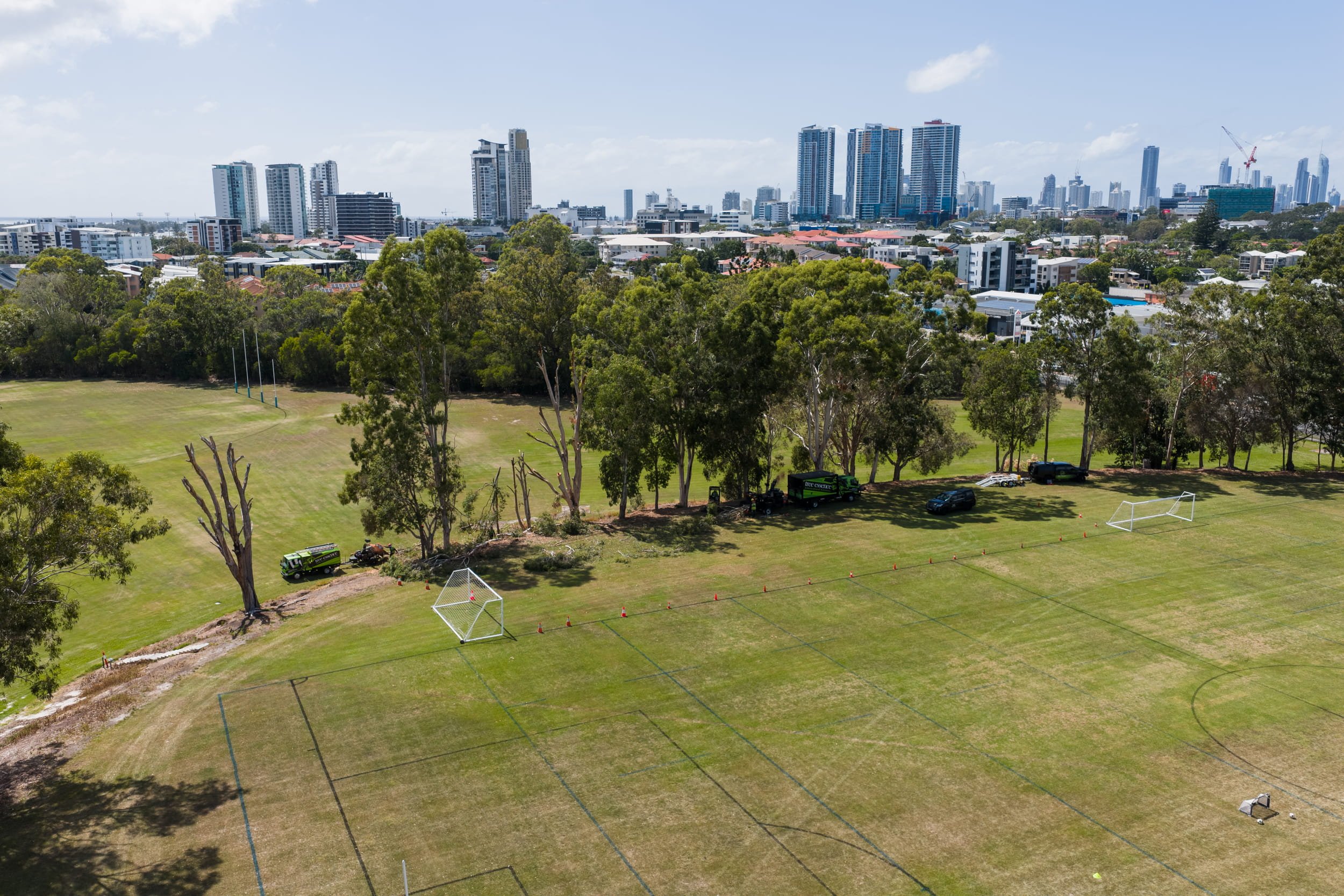
Southport State High School
[ CASE STUDY ]At a glance
Southport, Gold Coast, QLD
Location
Institutional long-term client, over ten years of continuous engagement
Relationship
Annual structural pruning, storm response, artificial hollow installation
Scope
Specialised habitat creation, high-tension storm damage, educational precinct safety
Technicality
Ecology, structural safety, institutional stewardship
Focus
Jamie Montgomery, AQF Level 5
Prepared by
[ OVERVIEW ]Ten years on the same grounds
The institution, and the relationship
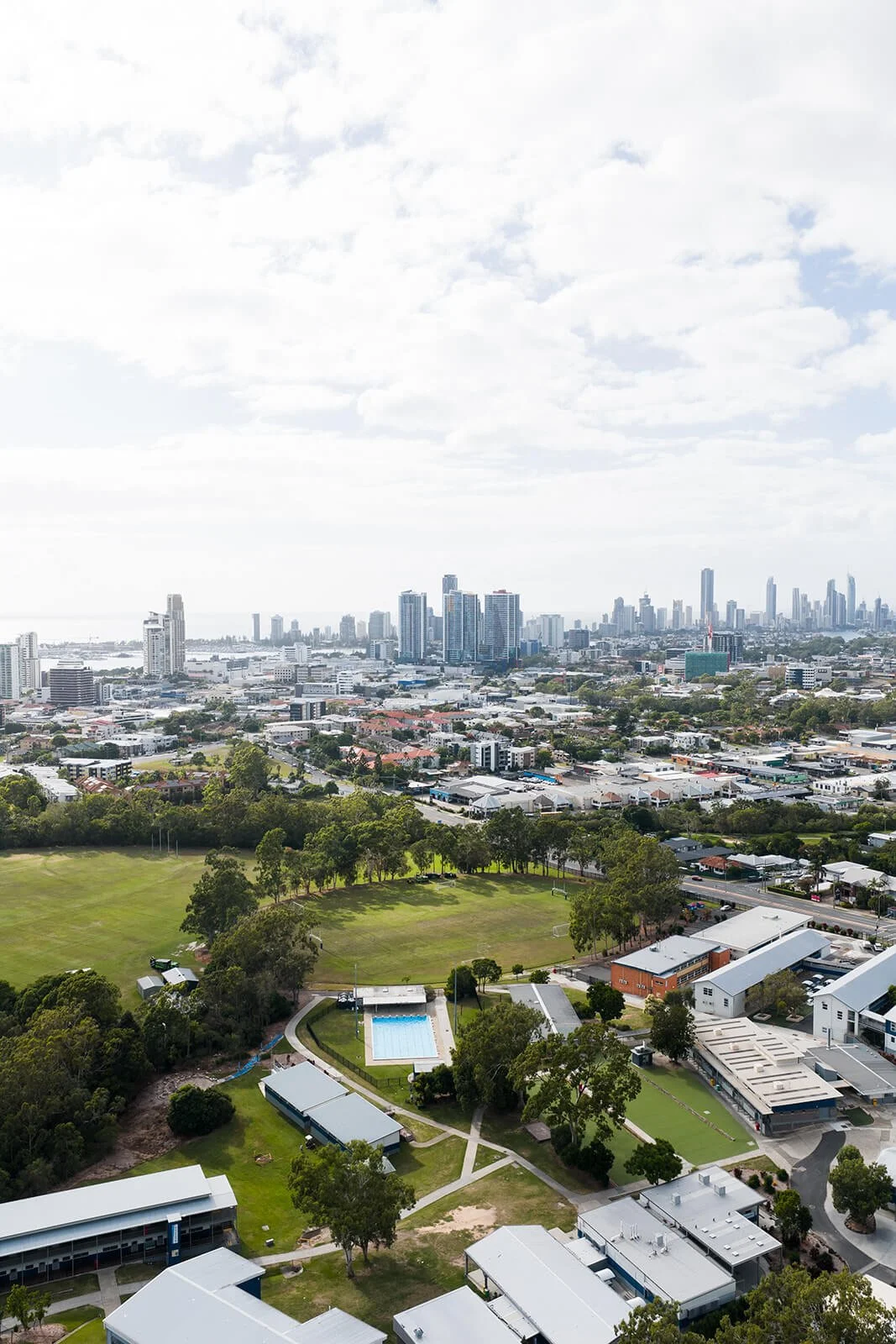
Southport State High School is one of our longest-standing clients, a relationship spanning more than ten years. Over that time we've managed the school's trees through routine structural programmes, urgent storm responses, and specialist ecological work, building the kind of site knowledge that's only possible through sustained, trusted engagement.
Institutional sites carry a distinct set of demands. Trees sit inside a complex environment of student welfare, duty of care, public liability, and timetable constraints. Works have to be coordinated around the school calendar, completed efficiently, and, above all, leave the grounds safe for the thousands of students and staff there every day. The longevity of the relationship reflects the school's confidence that we'll meet those demands every time.
The engagement
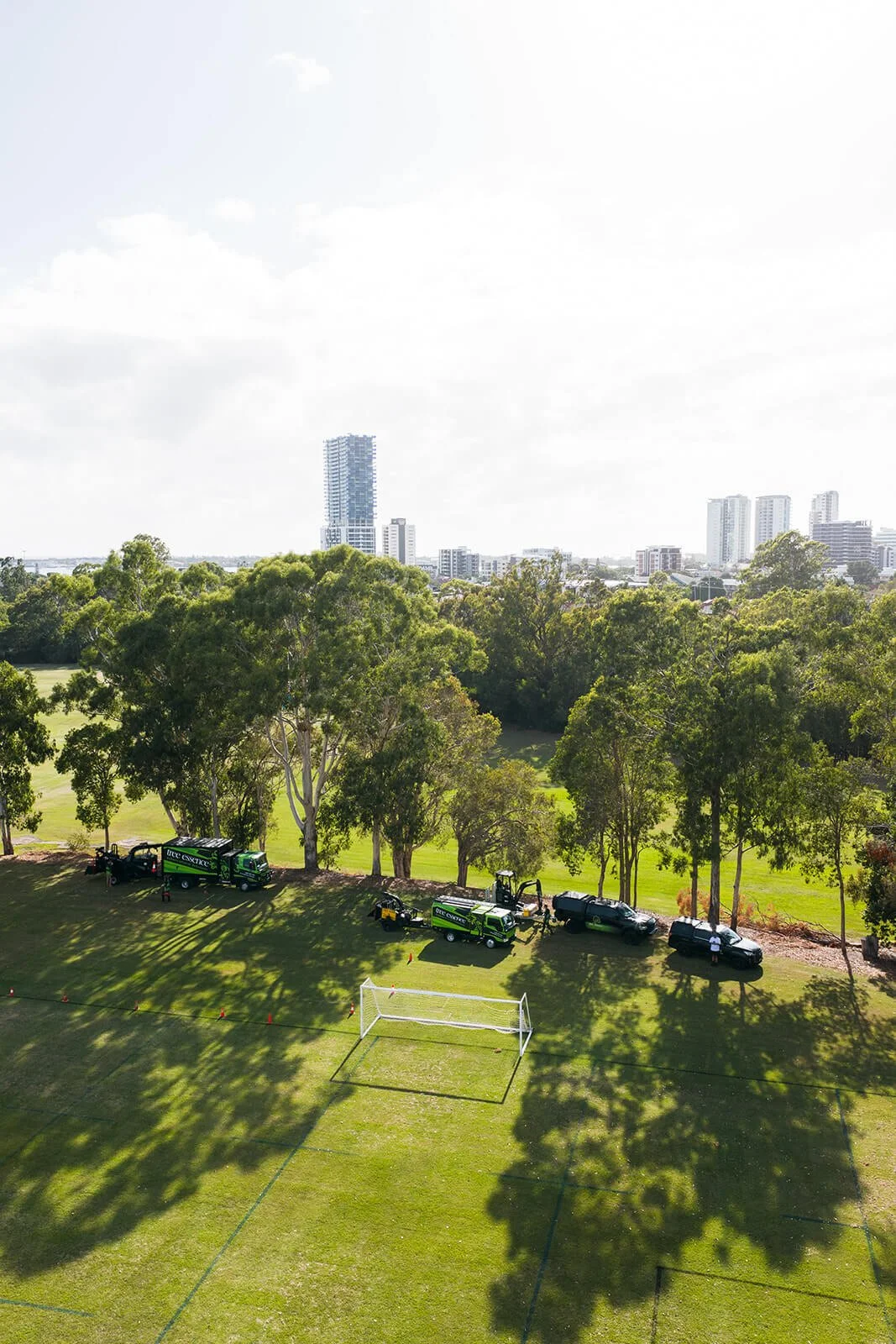
Over ten continuous years, Tree Essence has been the school's trusted arboricultural provider, attending annually for scheduled maintenance and responding whenever storms or urgent safety matters have required it. The relationship is built on consistent standards, clear communication, and a genuine commitment to the long-term health and safety of the school's trees.
[ THE WORK ]The annual programme
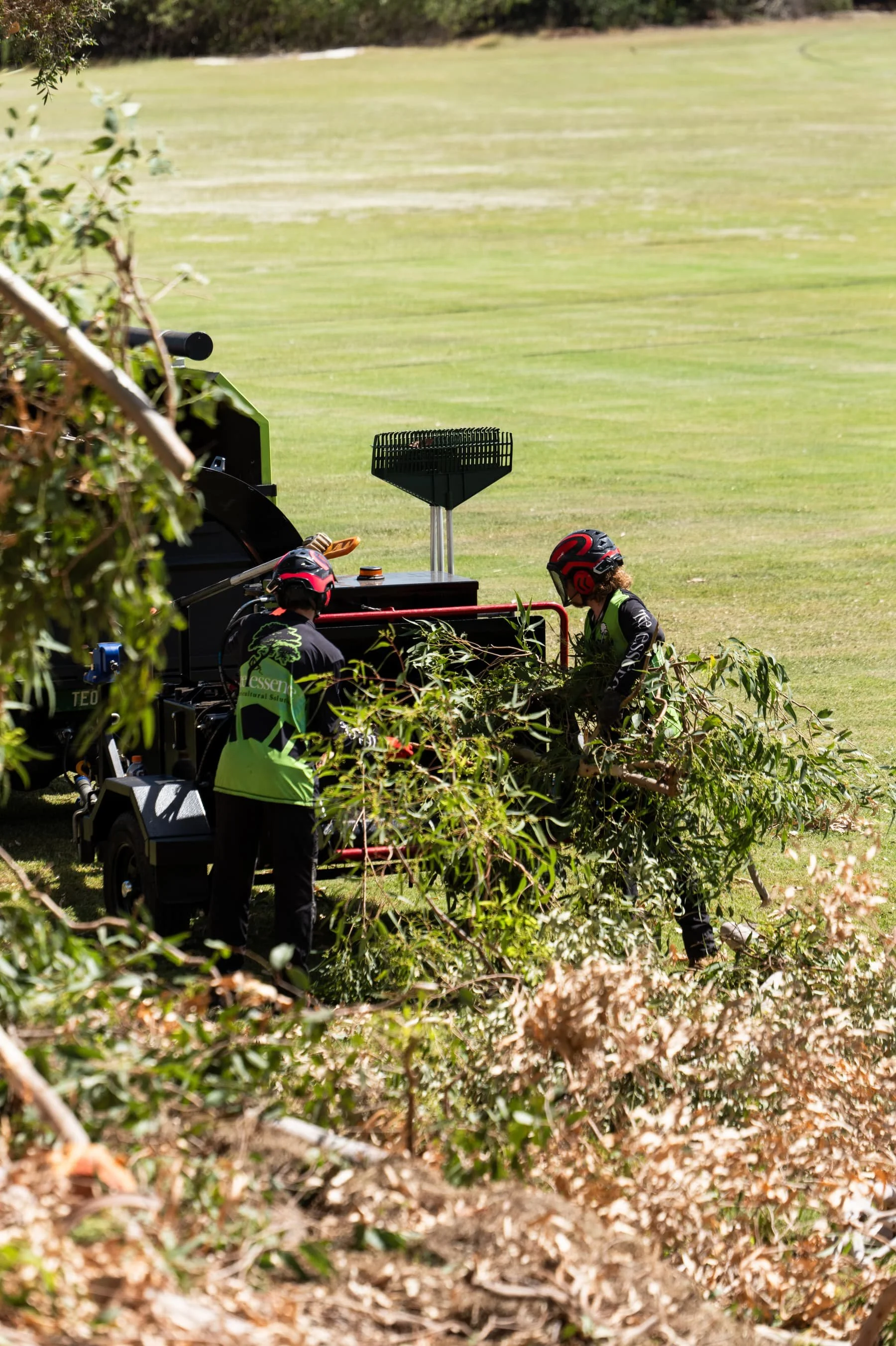
Each year we run a structured programme of maintenance across the grounds, designed to progressively improve structural integrity across the tree population, manage risk to students and infrastructure, and maintain the canopy's amenity and ecological value. Works are scheduled into holidays or low-activity periods to minimise disruption, and carried out by experienced crews equipped for an active educational precinct.
Annual works
Scope and purpose
Systematic pruning of all significant trees to Australian Standard: deadwood, weak unions, over-extended laterals, conflicting structure. Prioritised by risk rating and target proximity.
Structural pruning to AS 4373
Removal of all dead, dying, and compromised branches. In a high pedestrian-density environment, deadwood management is a non-negotiable safety obligation.
Deadwood & hazard limb removal
Elevating canopy over paths, buildings, and activity areas for sightlines, access clearance, and storm resilience.
Canopy lifting & clearance
Dynamic or static cabling at identified co-dominant unions and weak forks for supplementary support. Inspected and load-tested on every annual visit.
Bracing & cabling
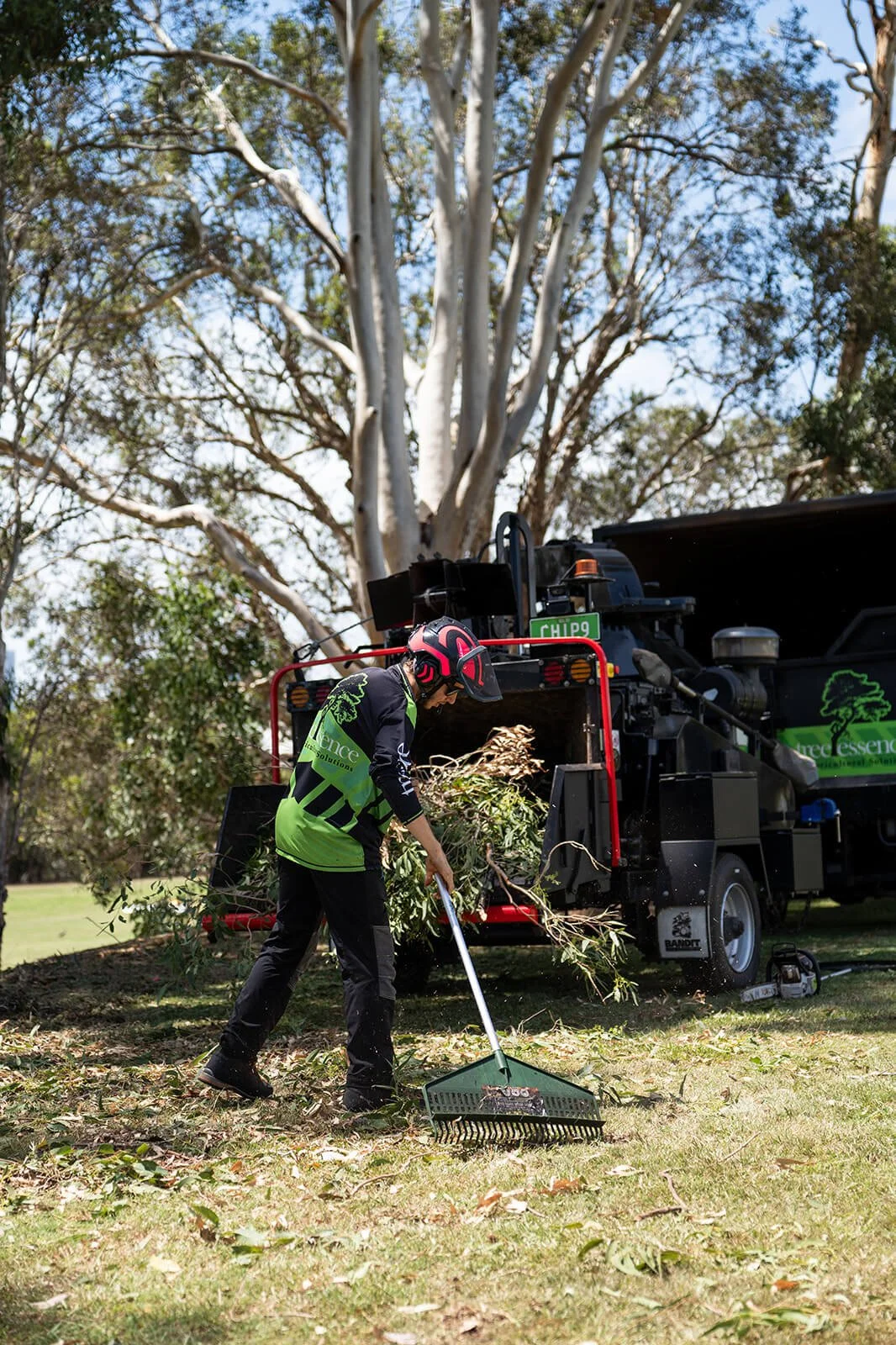
Thorough inspection and debris clearance after every operation, so the grounds are safe and presentable for the resumption of school activity.
Post-works ground inspection
Structural pruning of younger specimens to establish sound architecture before defects become embedded, reducing long-term cost and risk.
Young tree formative pruning
[ CALL-OUTS ]Storm response — eucalyptus crown failure, late 2025
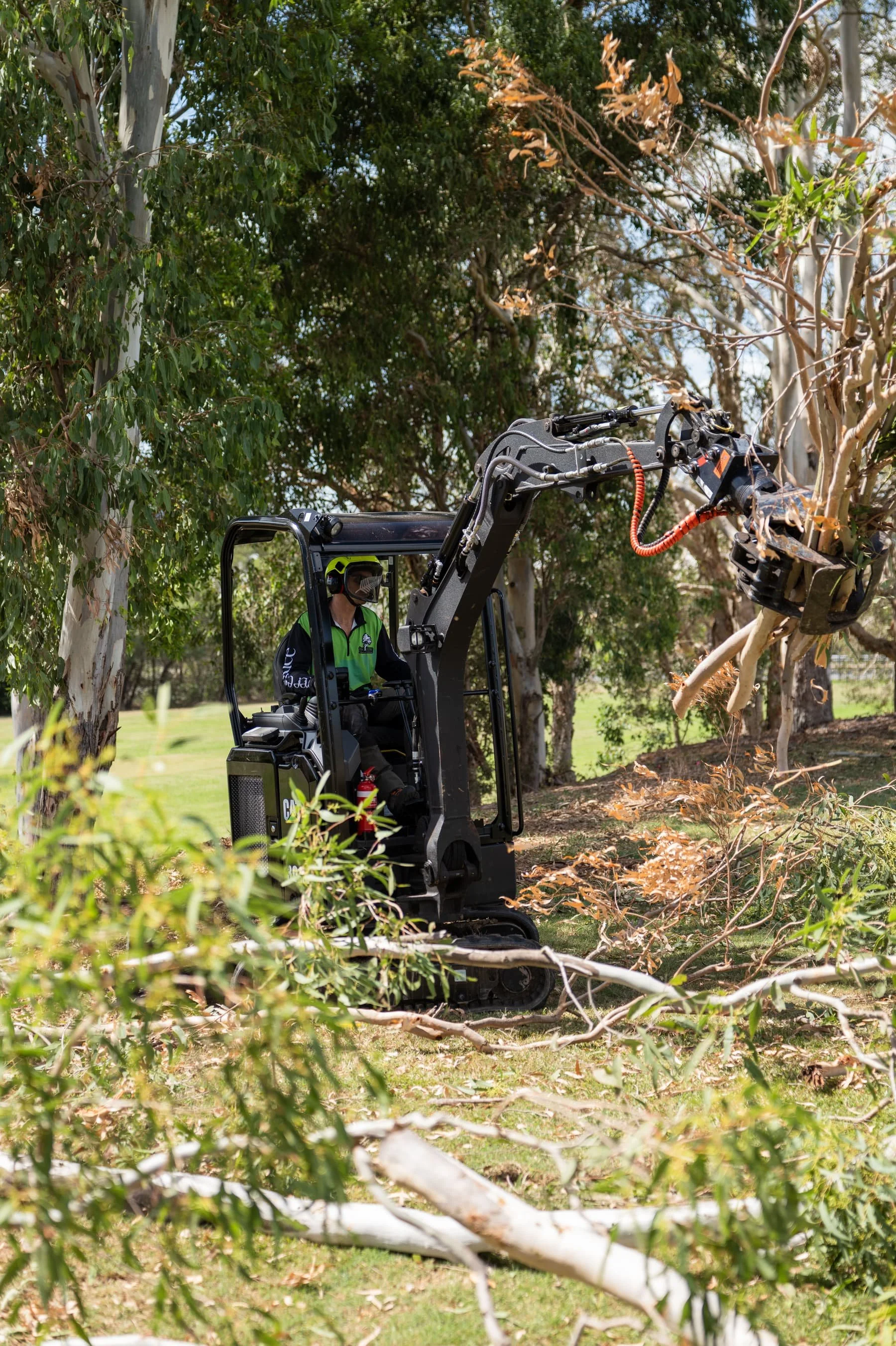
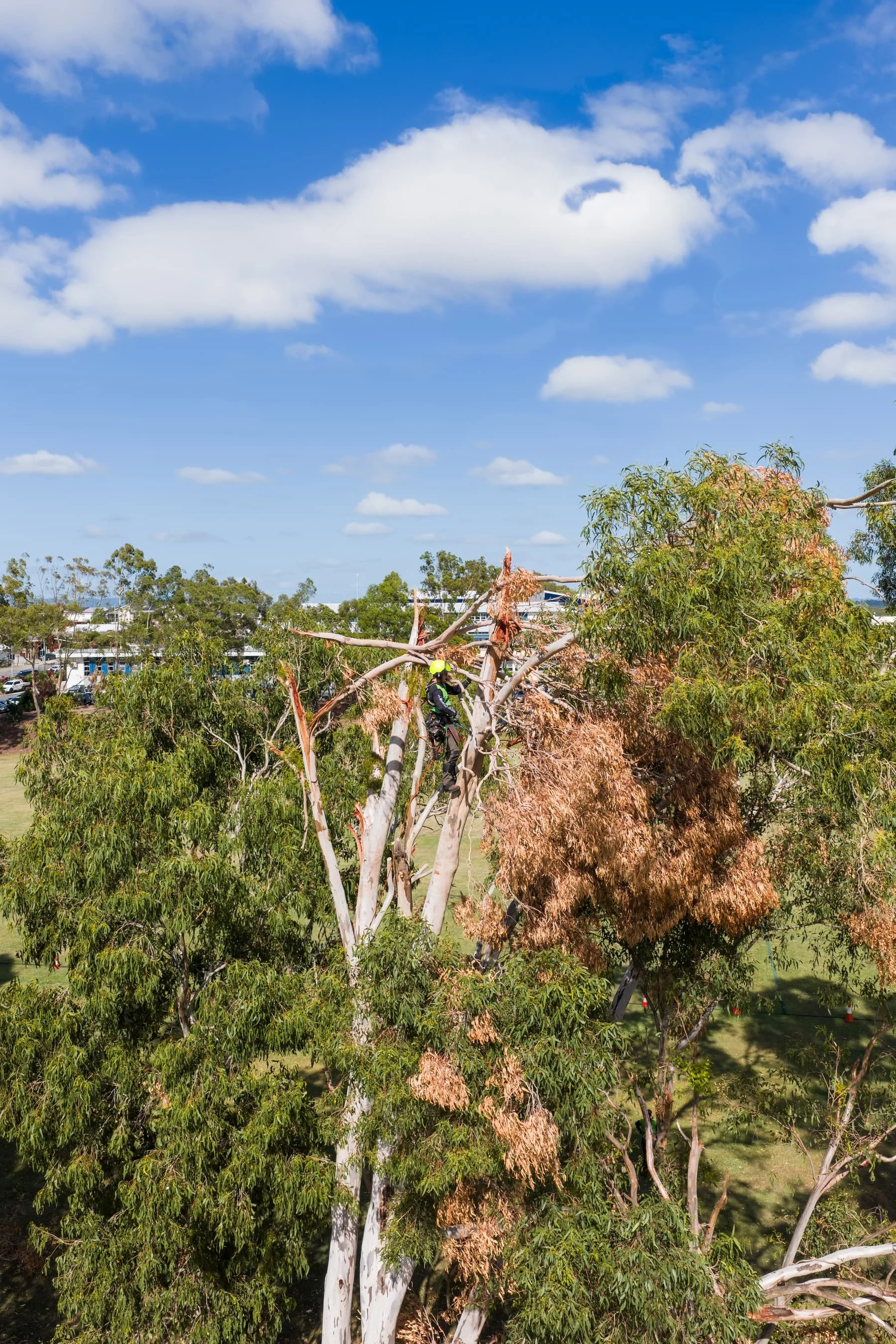
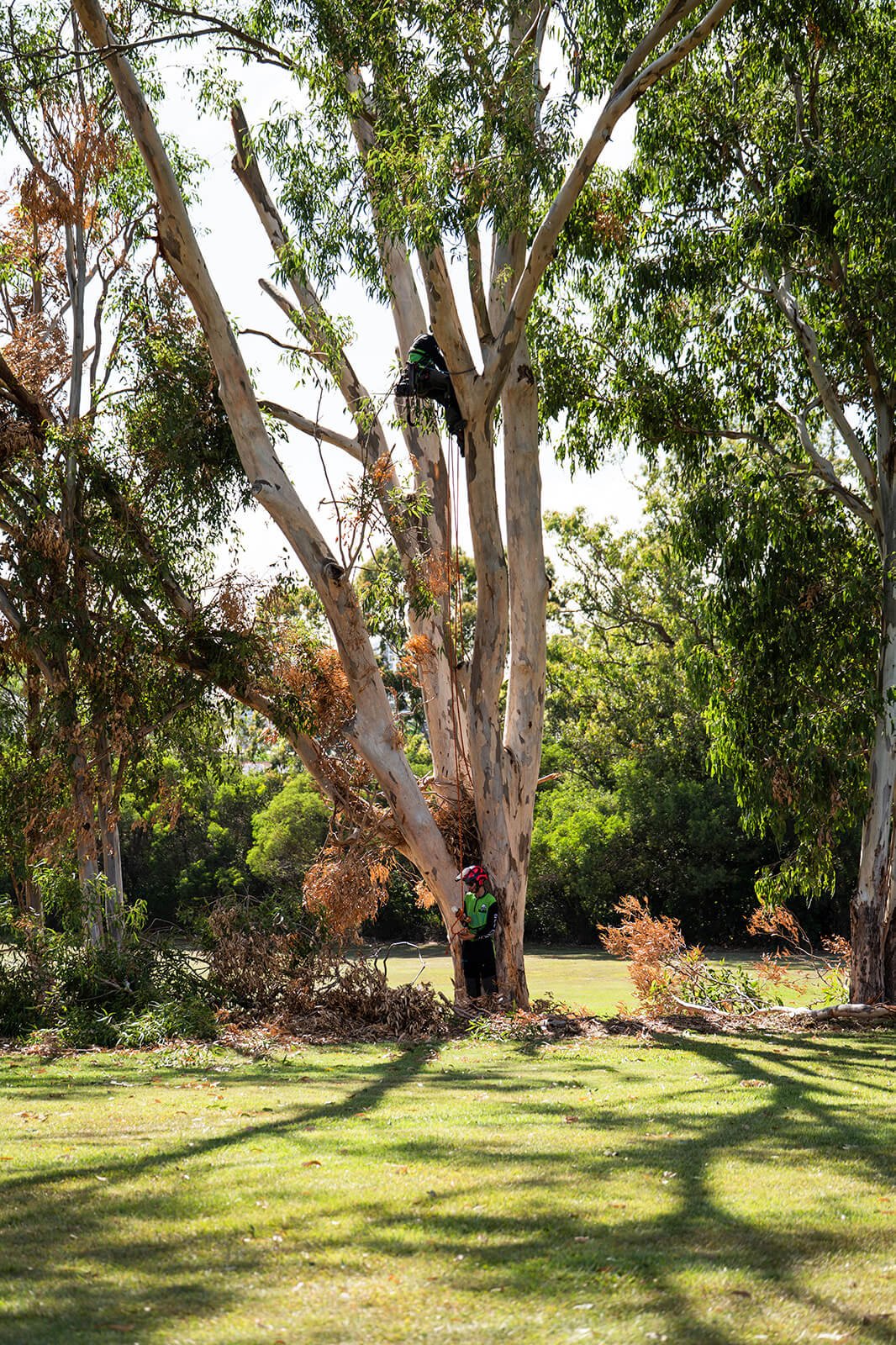
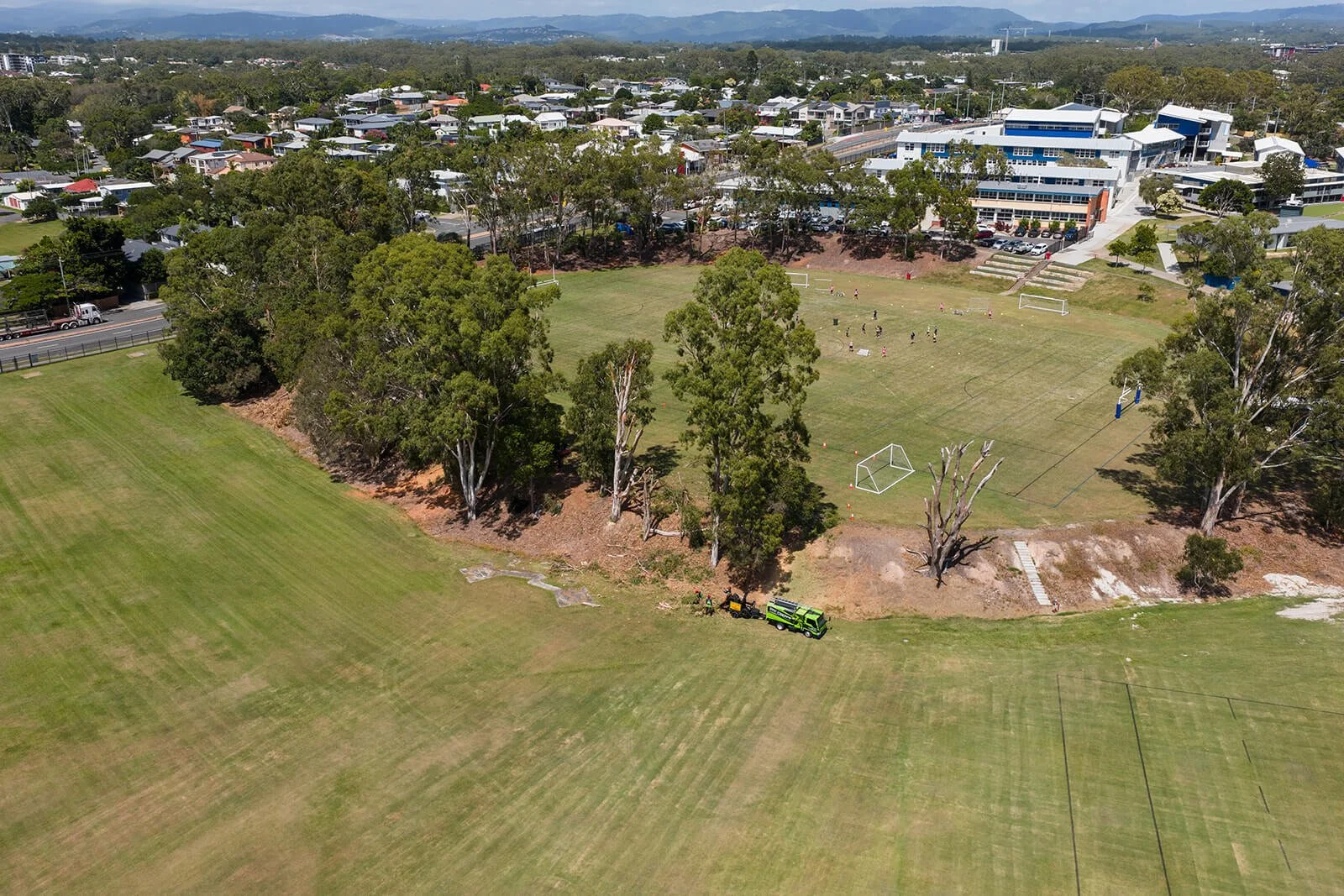
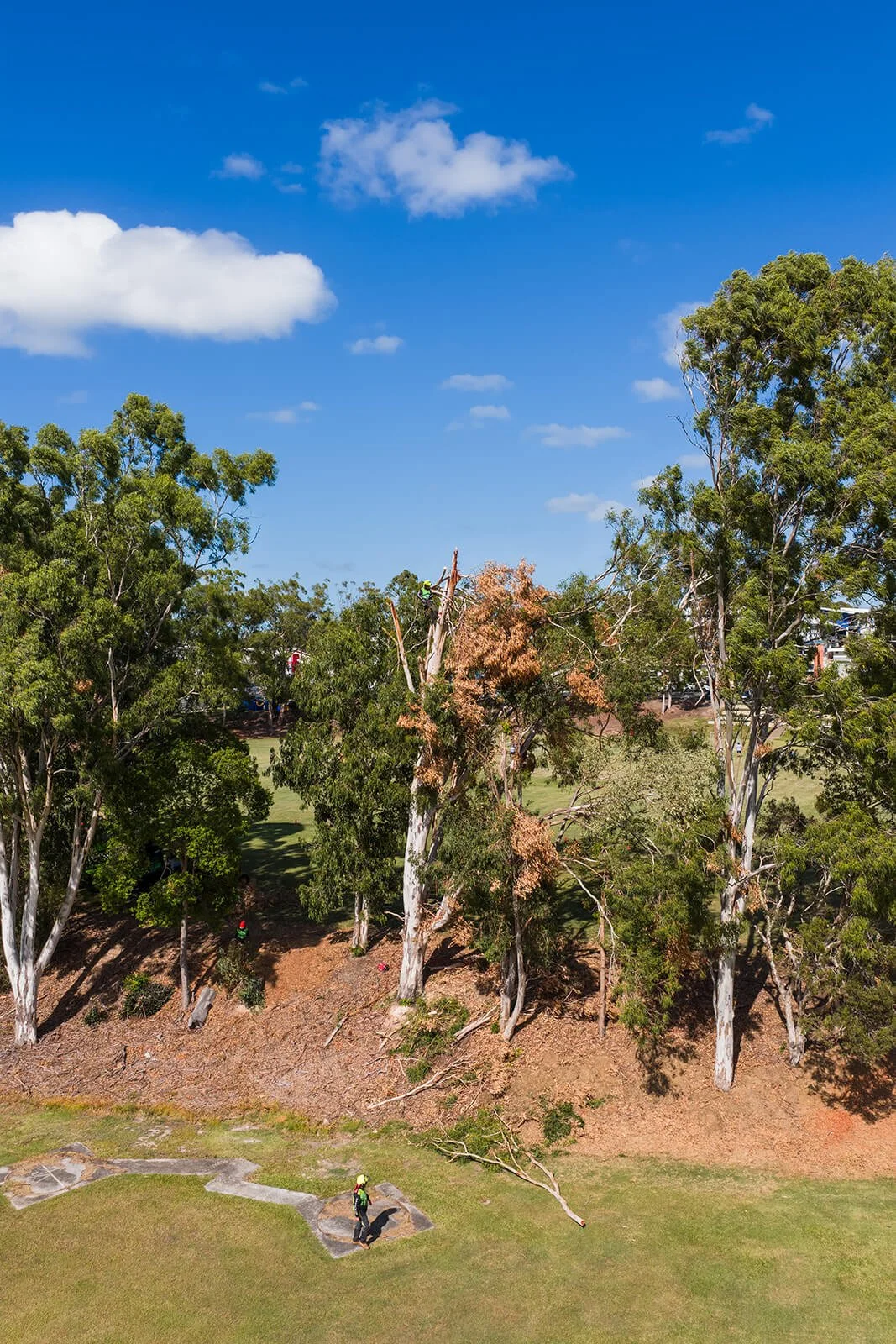
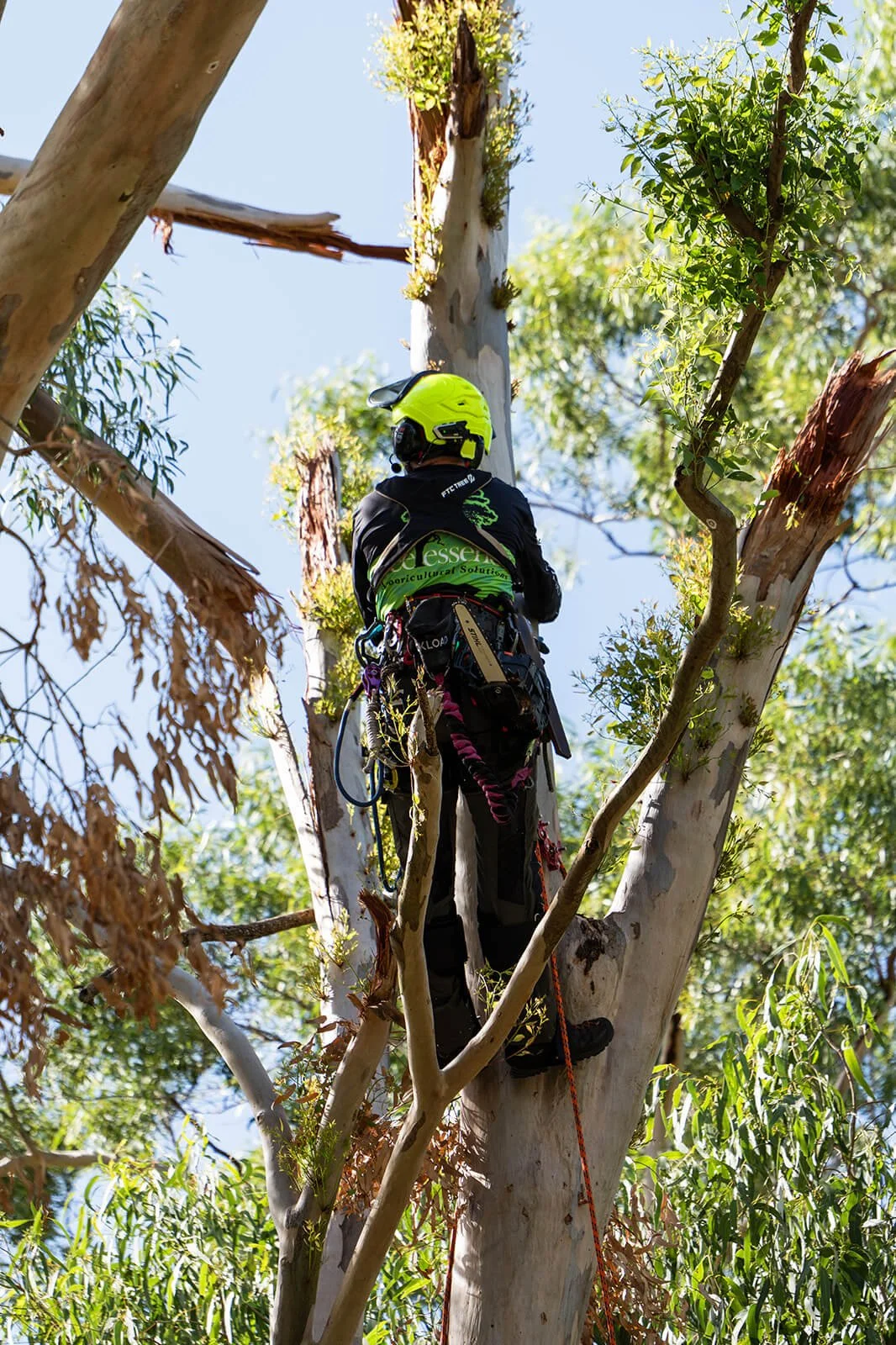
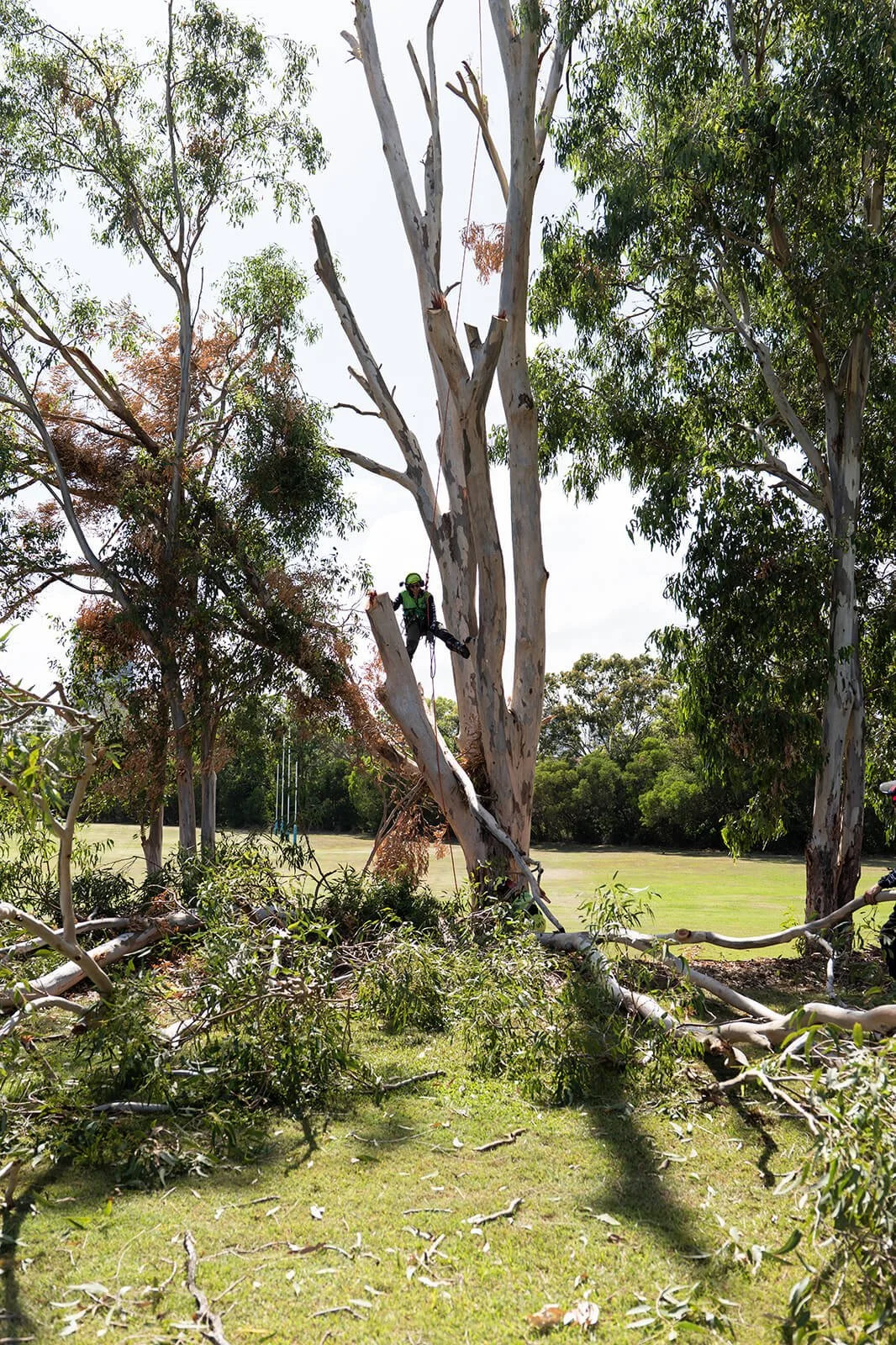
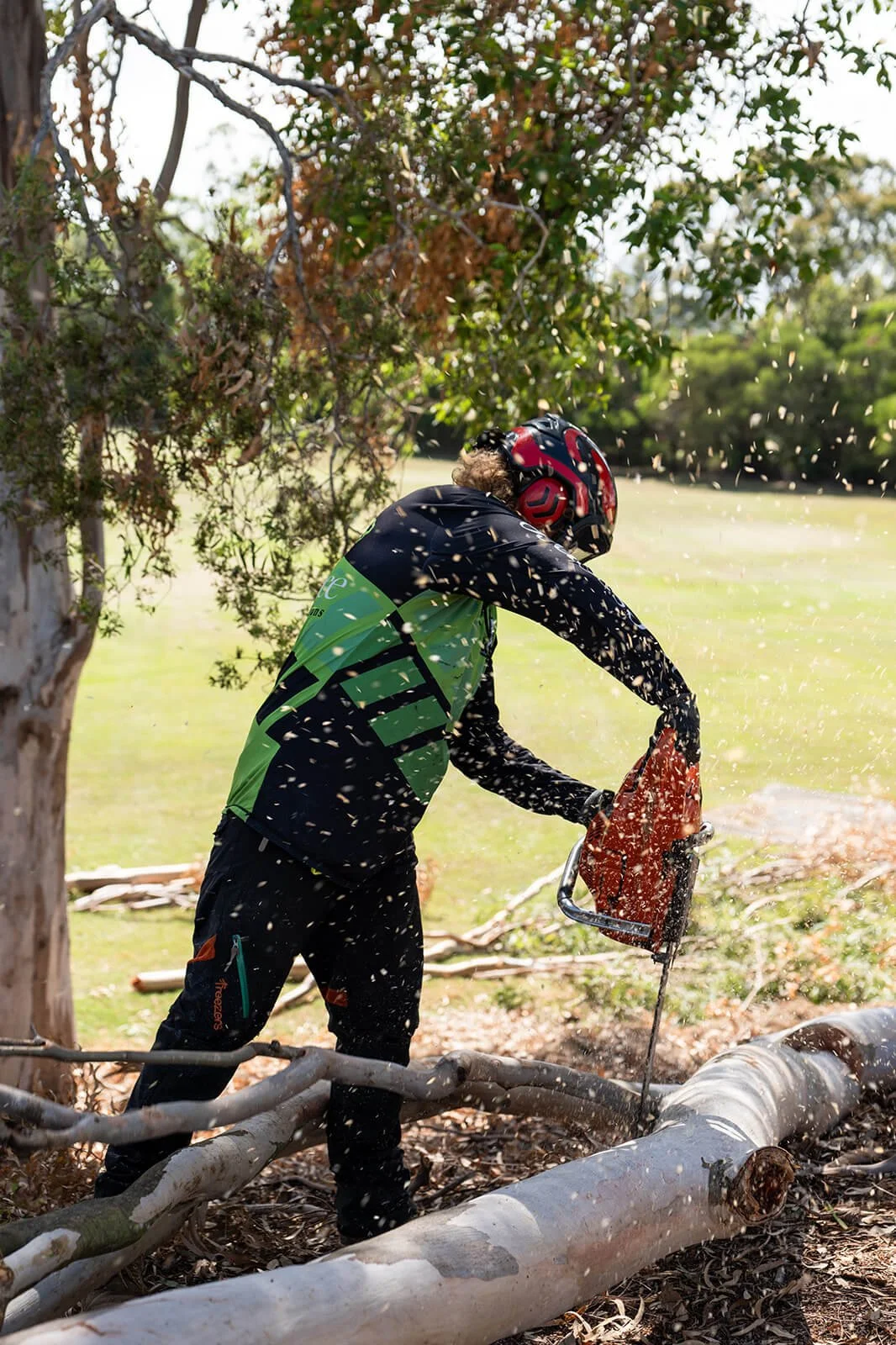
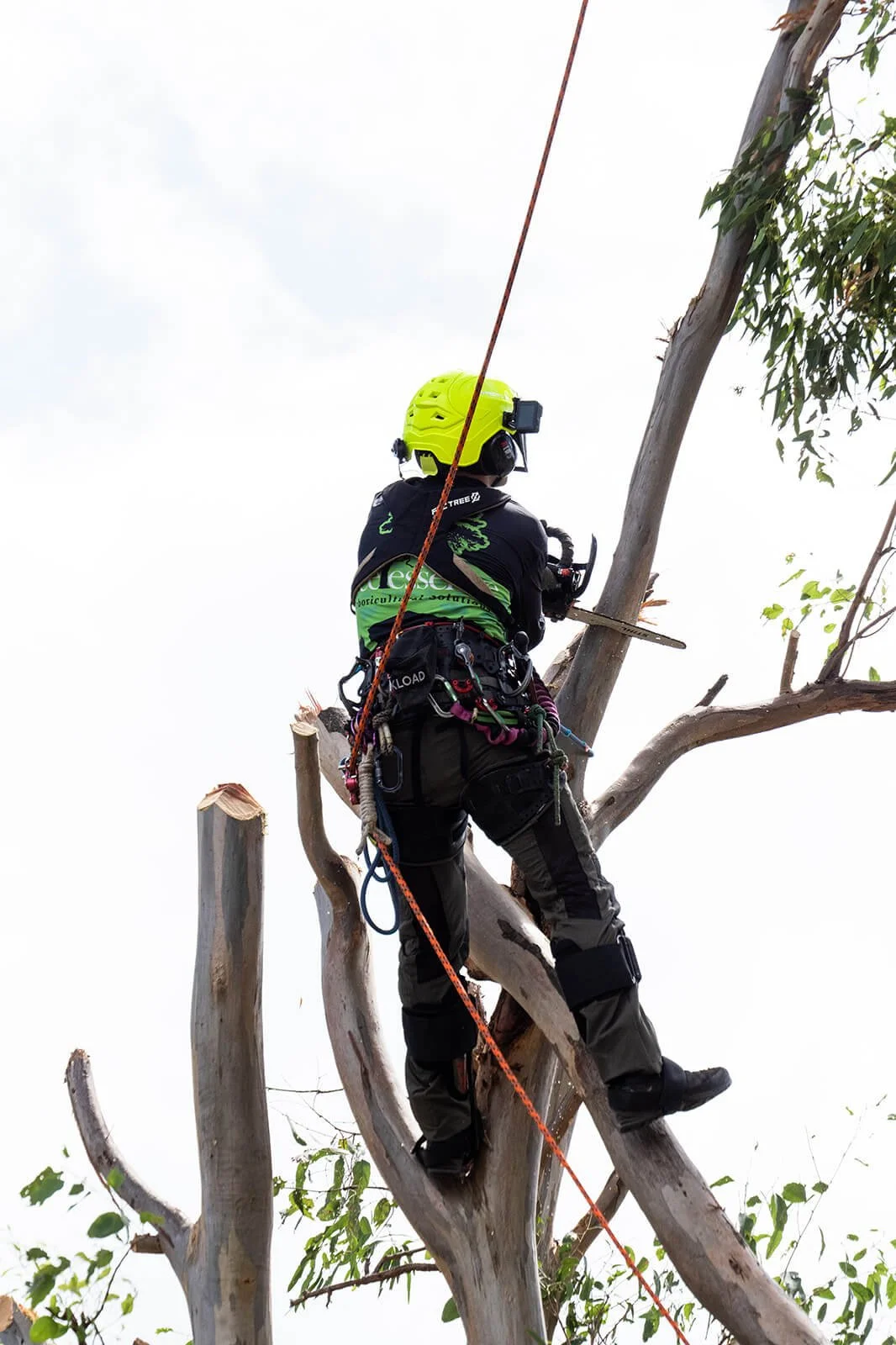
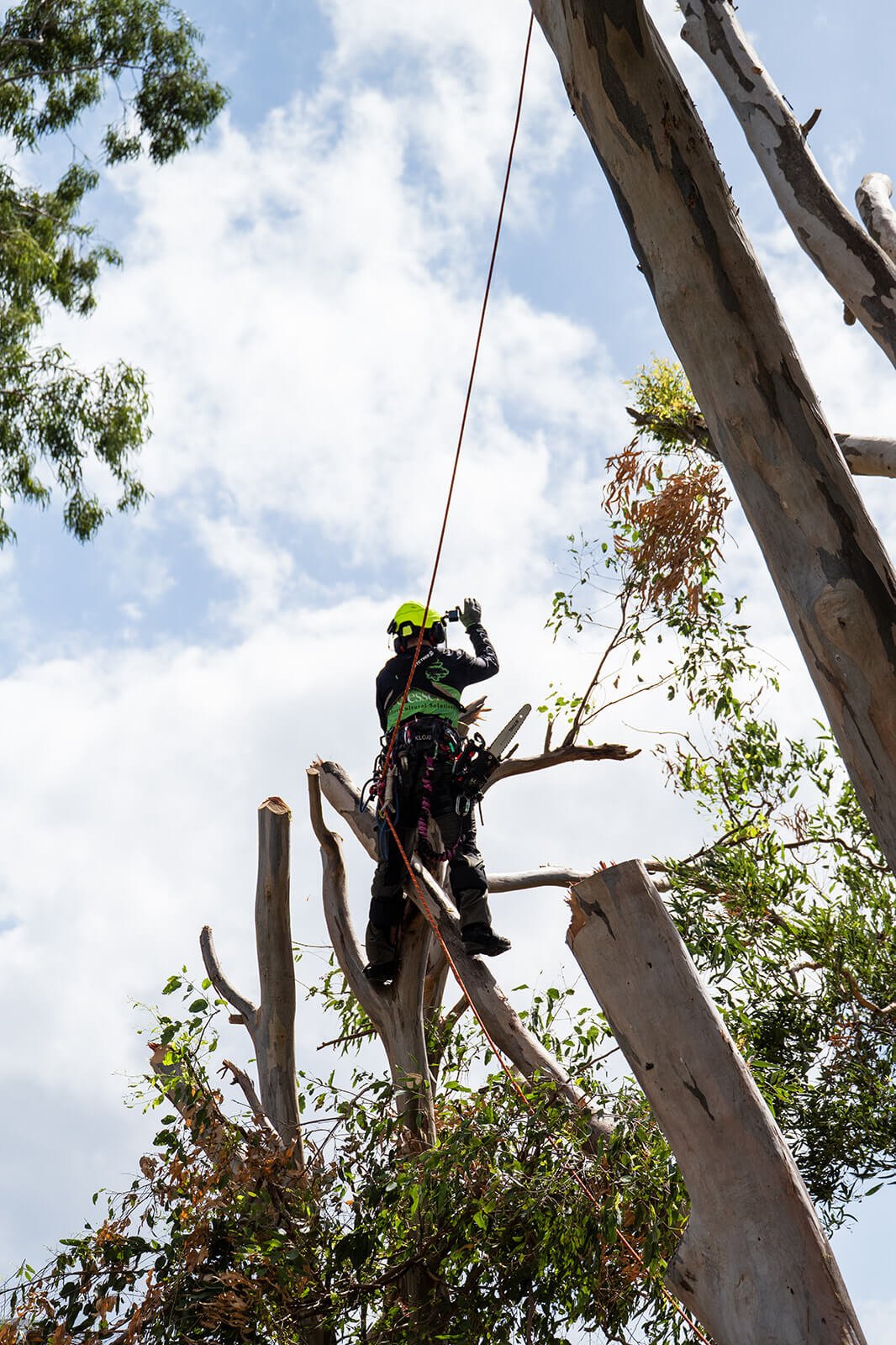
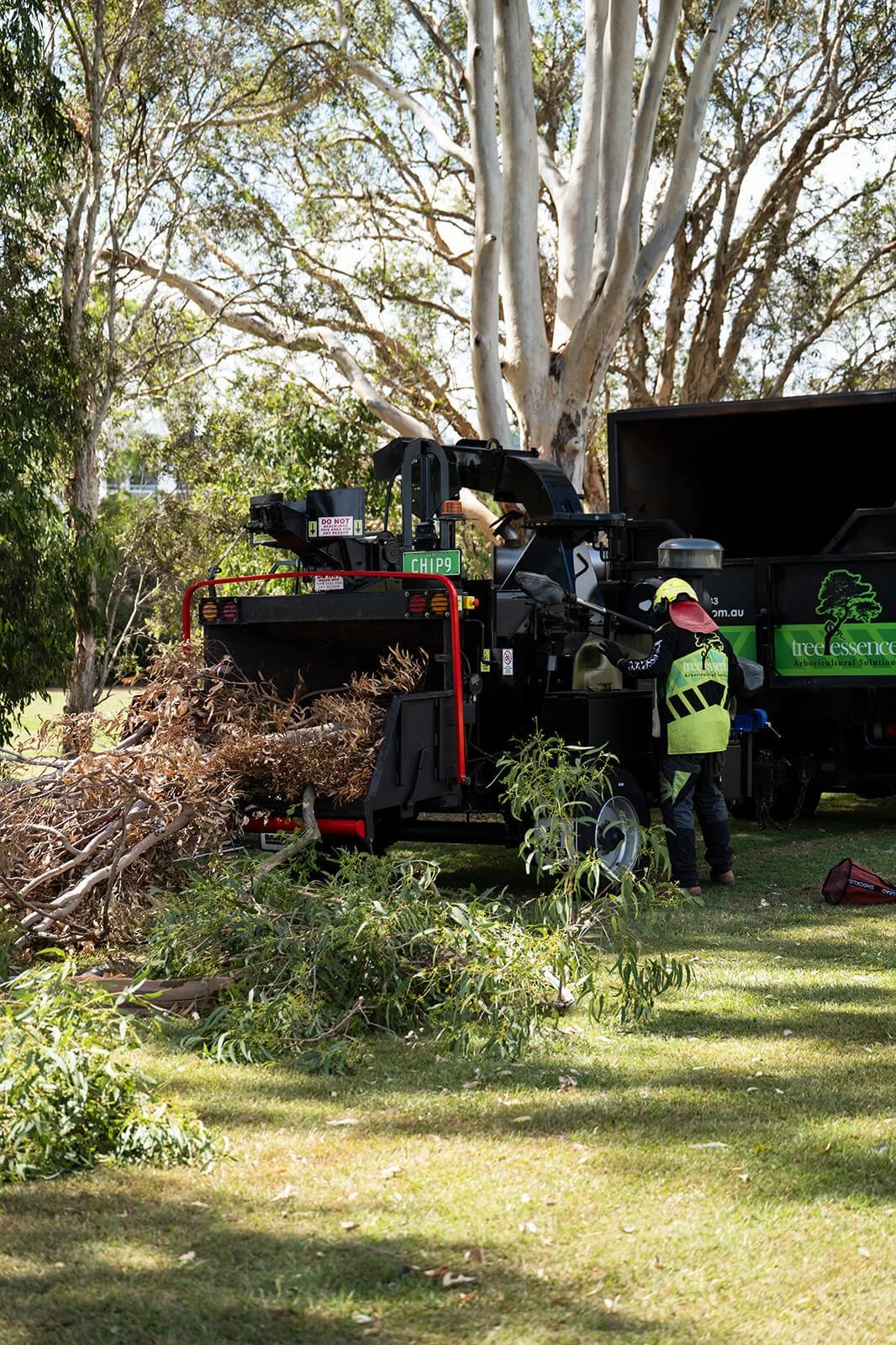
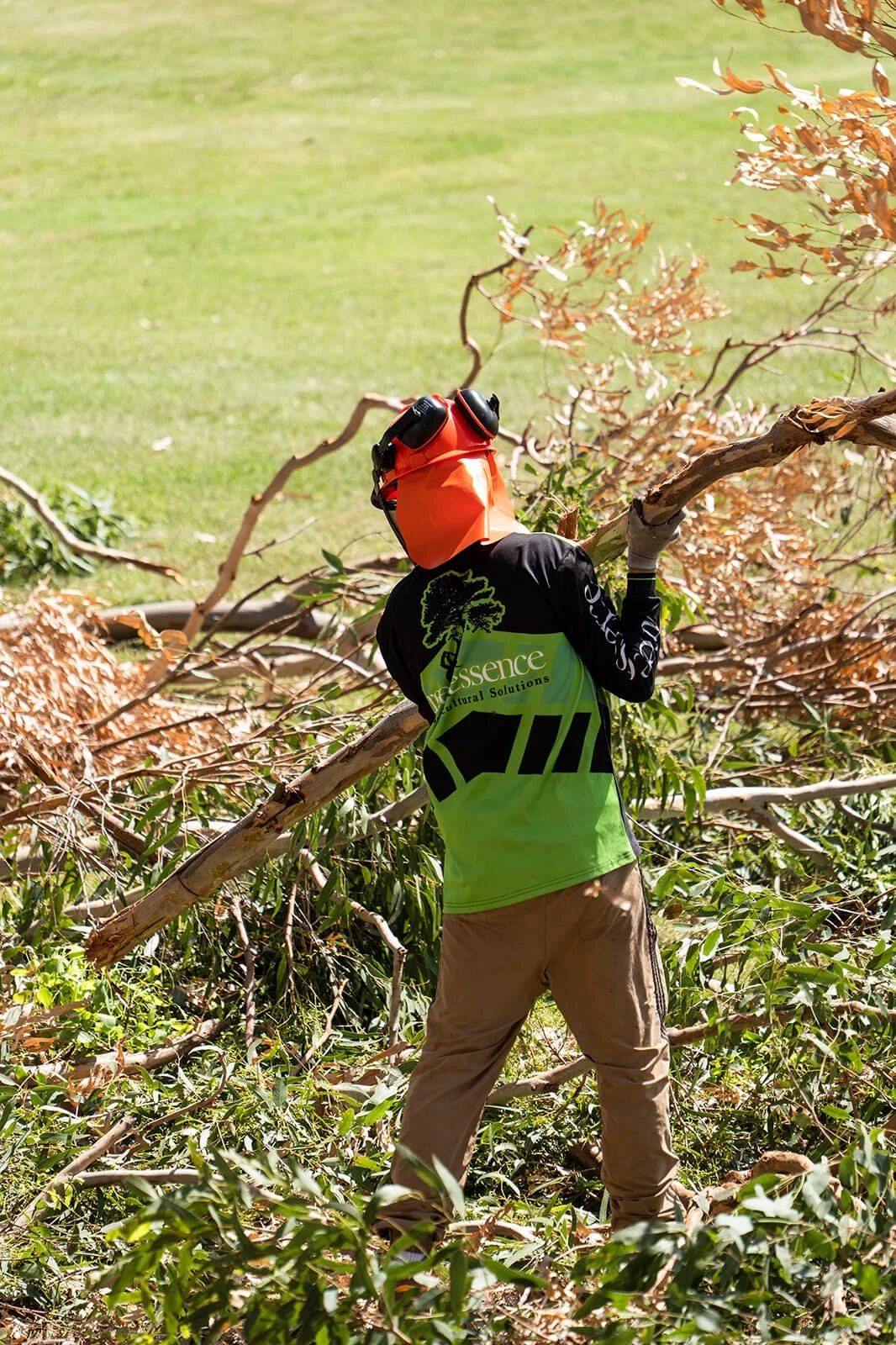
During the 2025 summer storm season, a large eucalyptus on the school grounds suffered catastrophic crown failure. The entire upper crown snapped under storm loading and remained suspended in the mid-canopy, a significant hung-up failure presenting an immediate hazard in an active school environment.
What happened
Large crown failures in mature eucalyptus are among the most technically demanding storm scenarios an arborist will face. The upper crown had separated at a point of weakness and lodged in the lower canopy, held in place by a web of interlocking branches and its own weight. The failure mass was substantial and under considerable residual tension, meaning a disturbed cut or poorly sequenced removal could trigger unpredictable, high-energy movement. The affected area was cordoned off pending our attendance.
Identifying the primary load-bearing contact points in the lower canopy before any cuts were made
Cutting from the outer extremities inward to progressively reduce the suspended mass
Using rigging and lowering lines to control each descent, preventing uncontrolled falls into the lower crown or onto the ground below
Continuously reassessing tension and movement, since load distribution in a hung-up failure changes dynamically as material comes off
Releasing the core hung section only once enough mass had been reduced for a safe, controlled lower
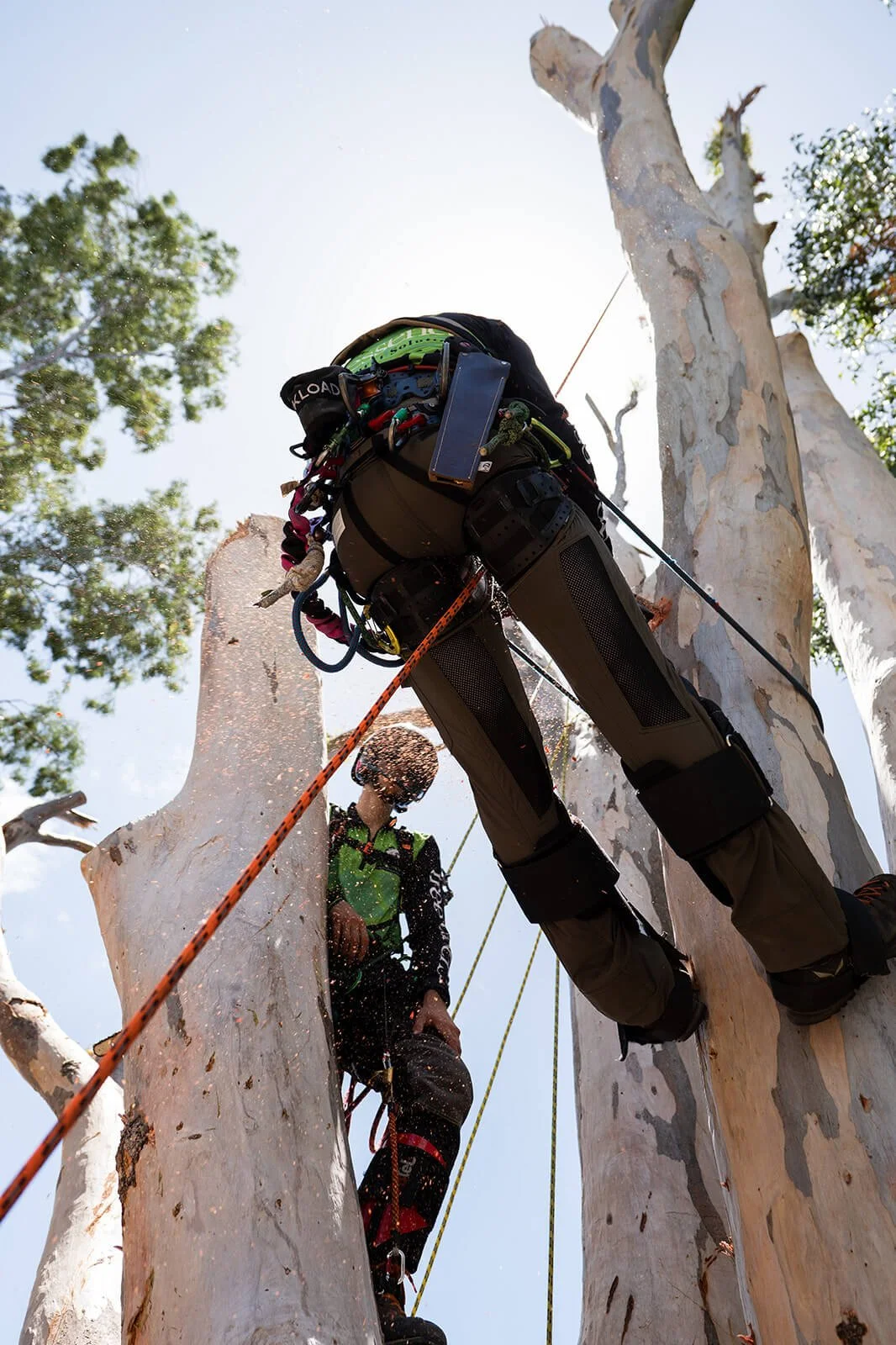
We assessed the failure before any works began, focusing on the load paths within the hung-up section: which branches were in compression, which were in tension, and how the mass would shift as elements were cut and released. The dismantle was then sequenced to relieve tension and weight progressively, using rigging to manage the movement of each section as it was freed:
The technical response
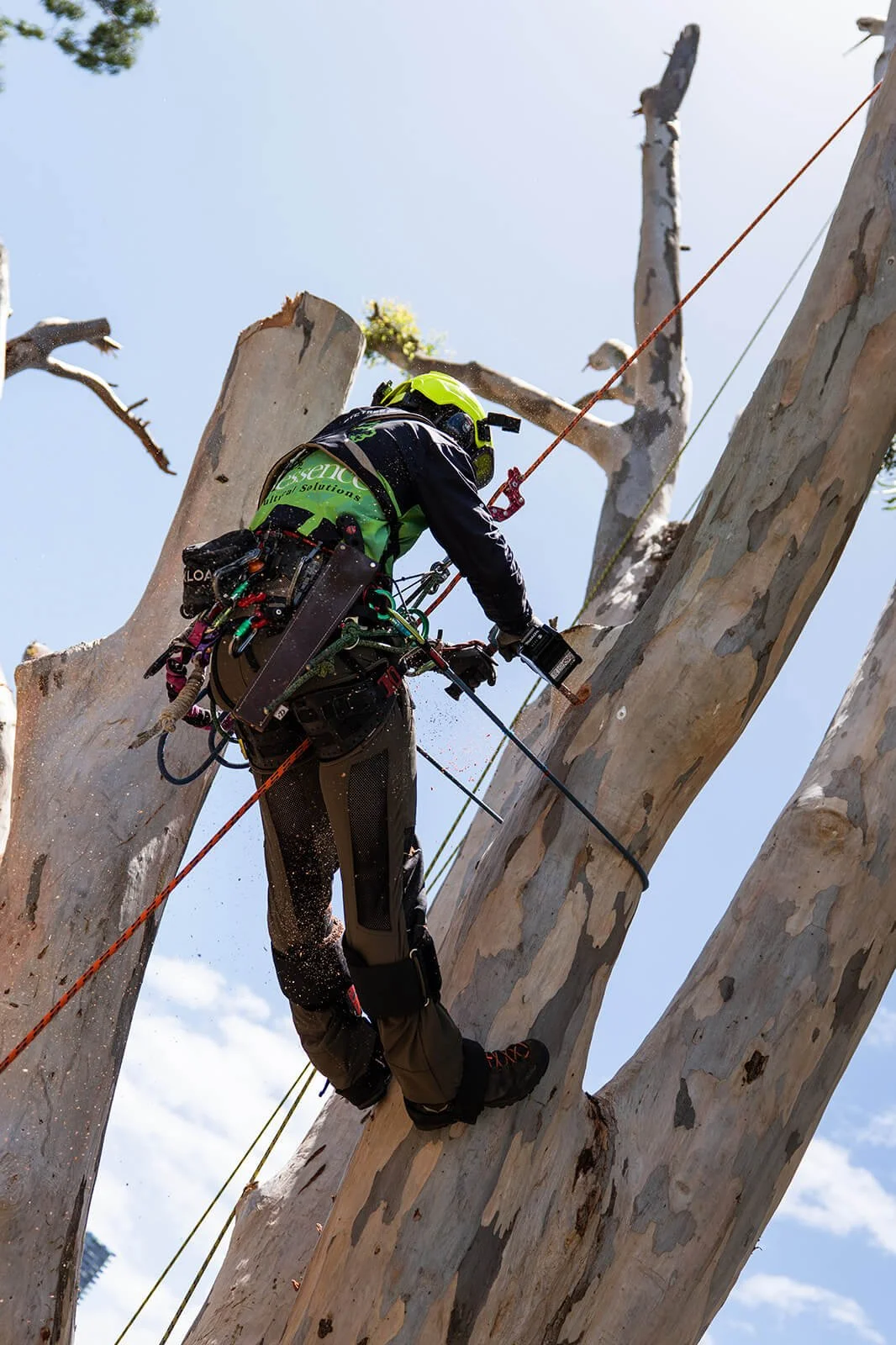
With the hung-up material clear, the retained lower stem and residual crown were left with the ragged break surfaces typical of storm damage. Rather than cut back to clean, conventional pruning wounds, we made a deliberate call: corrective cuts that followed and complemented the natural storm-damaged form. The cuts were positioned to promote compartmentalisation and long-term wound closure while respecting the natural lines of the break, so the tree reads as storm-shaped by nature, not crudely cut by machinery.
Finishing: keeping the storm aesthetic
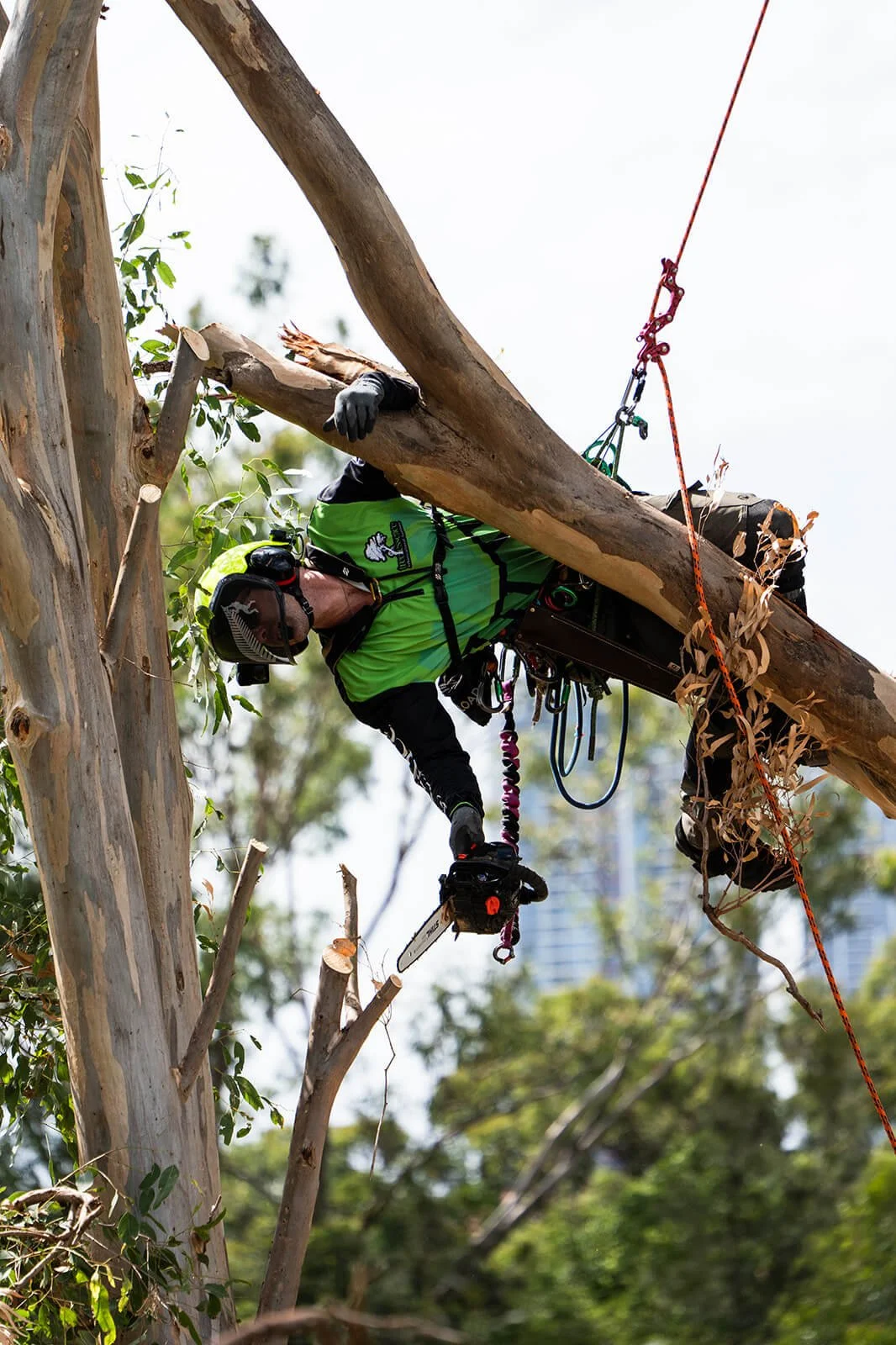
Making the right cut after storm damage is as much about what you leave as what you remove. A clean, blunt cut back to an arbitrary point would have been quicker, but it would have done nothing to honour the tree's character or support long-term wound closure. The corrective cuts followed the natural grain of the failure and were positioned to work with the tree's own compartmentalisation response.
Arborist note
[ ECOLOGY ]Turning the survivor into habitat
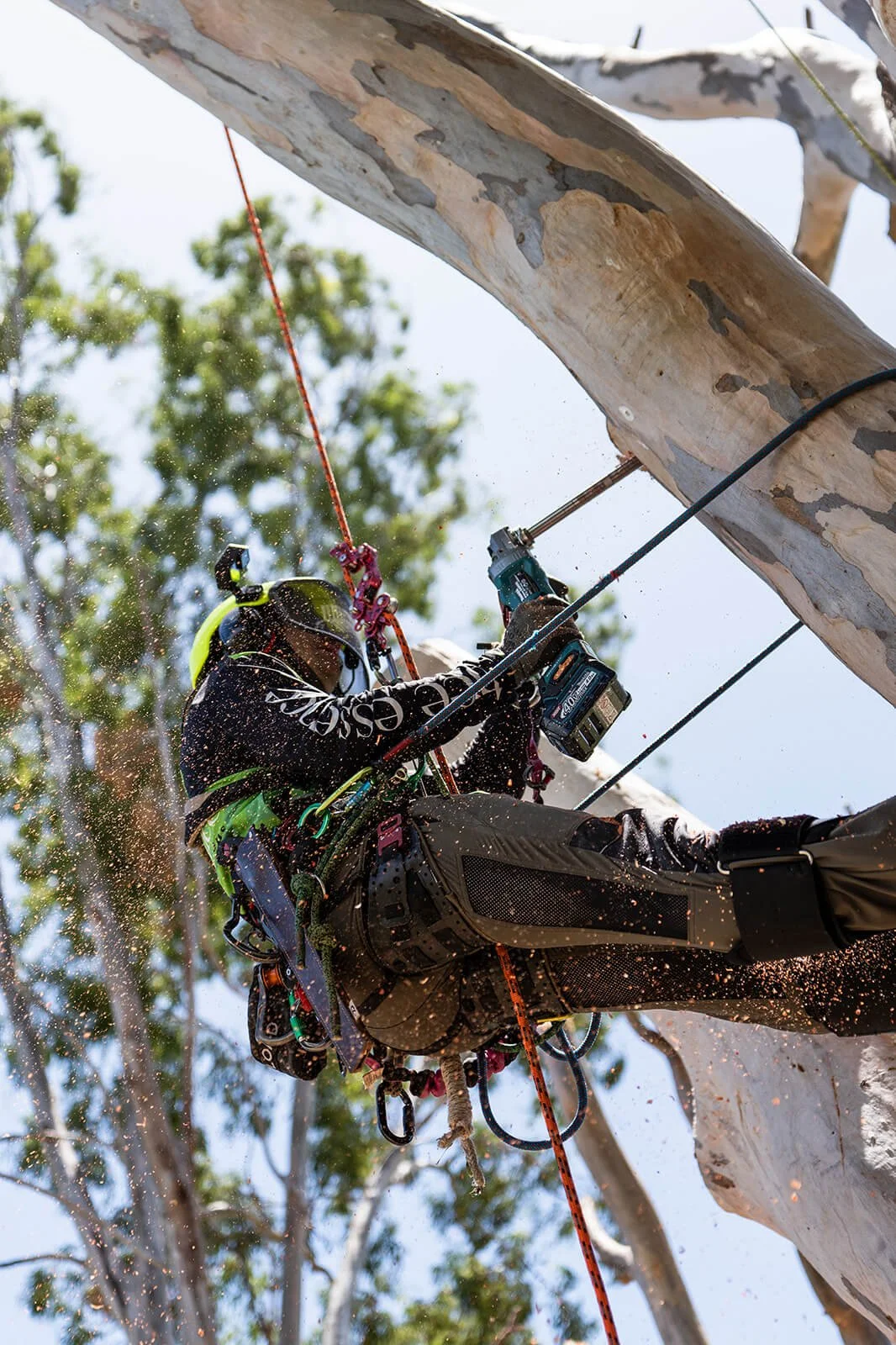
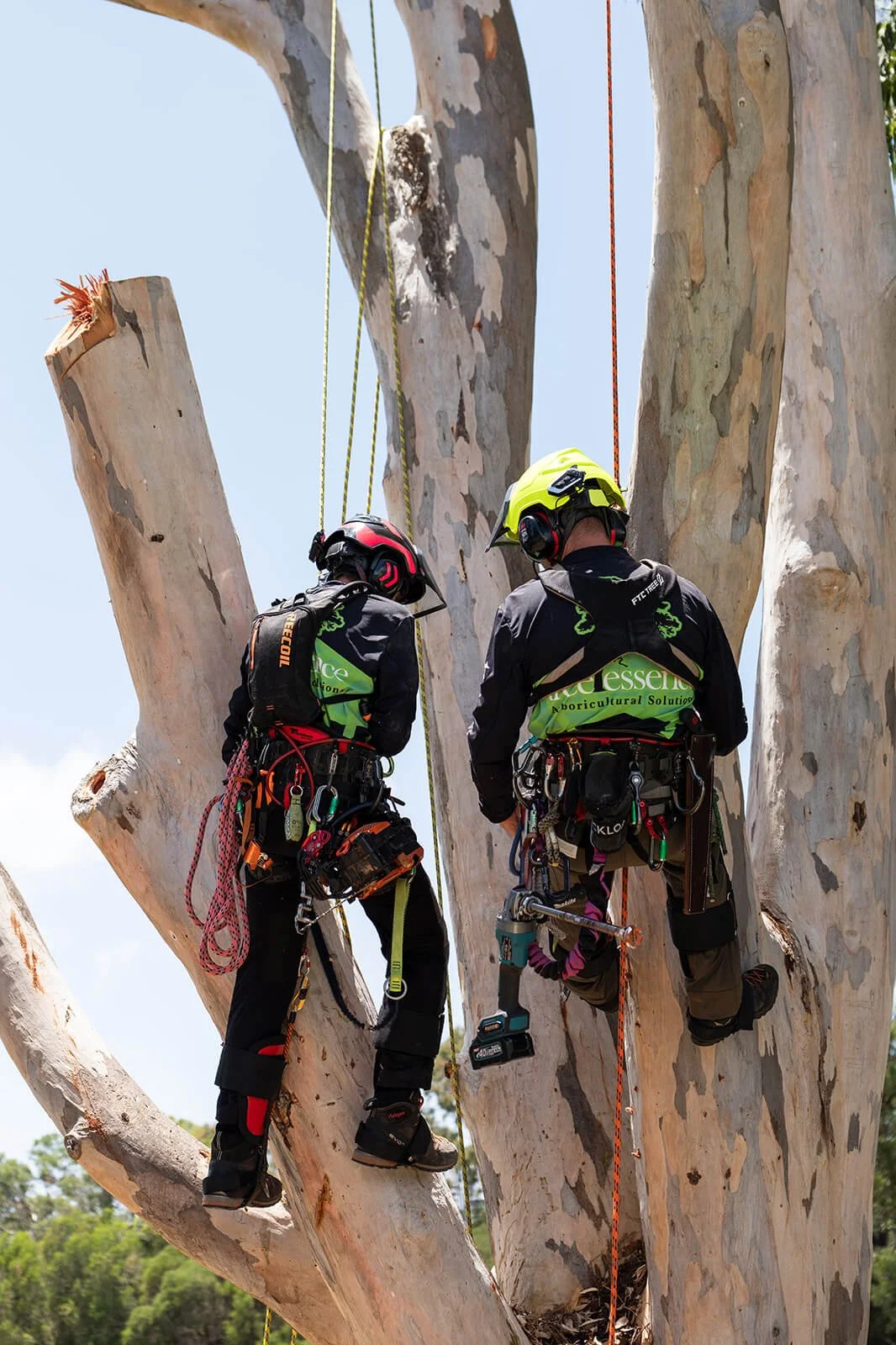
After the storm works, we installed a series of artificial hollows in the retained eucalyptus stem and crown. It was a specialist ecological intervention that turned a storm-impacted tree into an active wildlife habitat asset, and delivered lasting value from an event that could otherwise have only been destructive.
Tree hollows are among the most ecologically significant features in the Australian landscape. They provide nesting, roosting, and shelter for possums, gliders, microbats, owls, parrots, and lizards. Many of these are obligate hollow-users that can't reproduce or survive without a suitable cavity. The challenge is time. Natural hollows form through a slow, multi-stage process: a wound or mechanical disturbance to the heartwood, then decades of fungal decay, bacterial action, and weathering.
Key ecological fact
A hollow large enough to be useful to wildlife takes more than 100 years to form in most Australian eucalypts. The large hollows used by threatened species like Glossy Black-Cockatoos and Greater Gliders are often found only in trees 200 years or older.
In a landscape where old-growth trees have been progressively cleared, the shortage of hollow-bearing trees is one of the primary drivers of decline in hollow-dependent native species across South East Queensland. Urban and peri-urban settings, school grounds included, are almost entirely without hollow-bearing trees of sufficient age. That's what makes artificial hollow installation genuinely impactful: it introduces hollow resources into the landscape decades, even centuries, ahead of what nature would produce.
Hollows are specified, not generic. Internal dimensions, entrance aperture, depth, orientation, and installation height are each set according to the target species. Get it wrong and the hollow either goes unused or attracts the wrong occupant, including pests like Common Mynas and feral pigeons. We design each installation around the fauna likely to occur at the site, informed by local ecology and relevant wildlife guidelines. At Southport, hollows were specified for the endemic species most likely to use the habitat on and around the grounds.
| Target species | Entrance | Internal depth | Install height | Notes |
|---|---|---|---|---|
| Common Ringtail Possum | 70 mm | 350 mm min | 3 m+ | Smaller entrance deters larger competitors |
| Common Brushtail Possum | 120 mm | 500 mm+ | 4 m+ | Larger cavity, robust construction |
| Microbats (general) | 25–30 mm slot | Shallow roost box | 3–5 m | Orientation critical, warm northerly aspect preferred |
| Rainbow / Scaly-breasted Lorikeet | 60 mm | 400 mm+ | 4 m+ | Competitive nesters; separated from possum hollows |
| Tawny Frogmouth (roost) | Open platform | Minimal | 3–5 m, dense cover | Roosting not nesting; camouflage a priority |
How they were installed
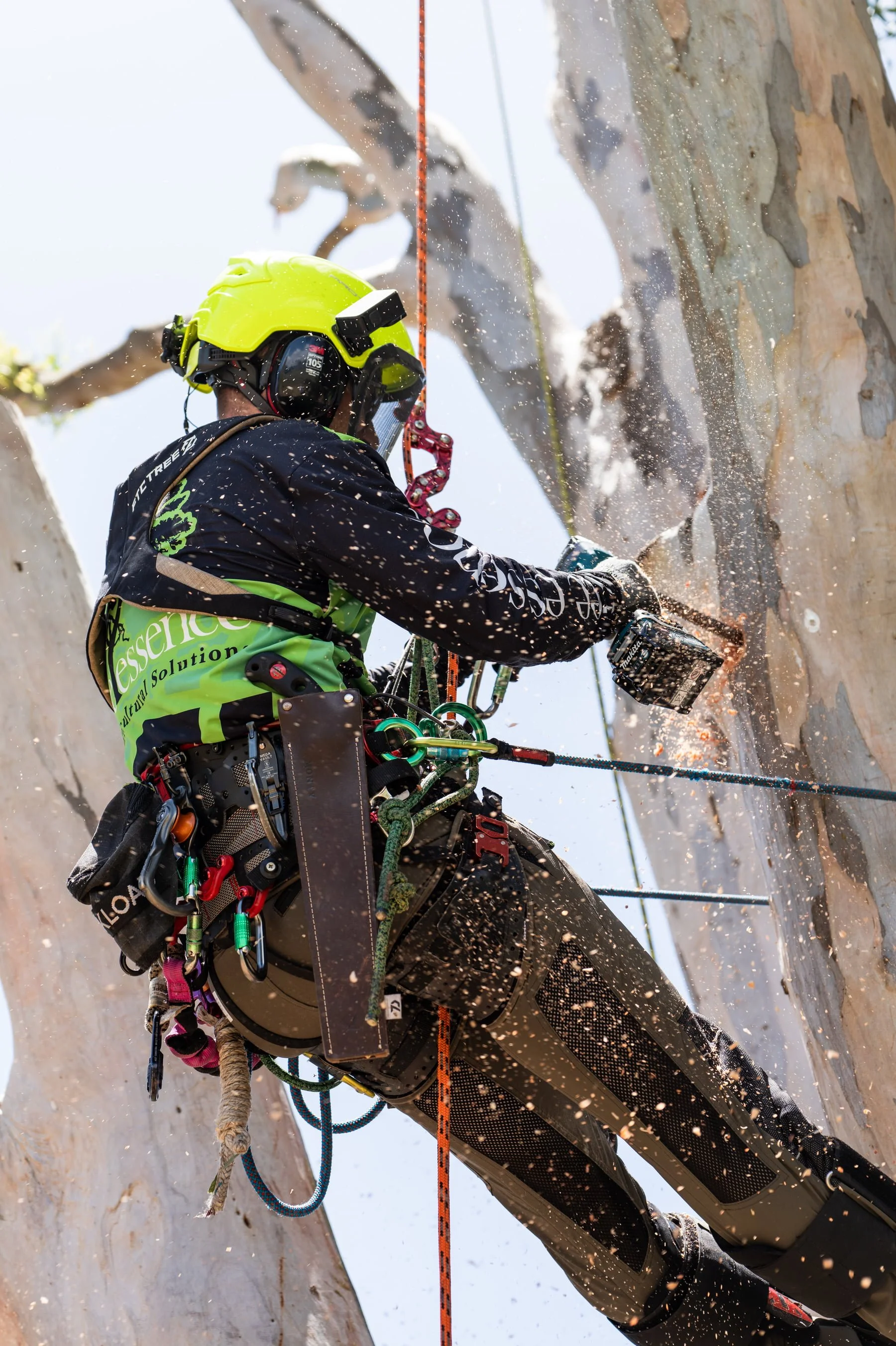
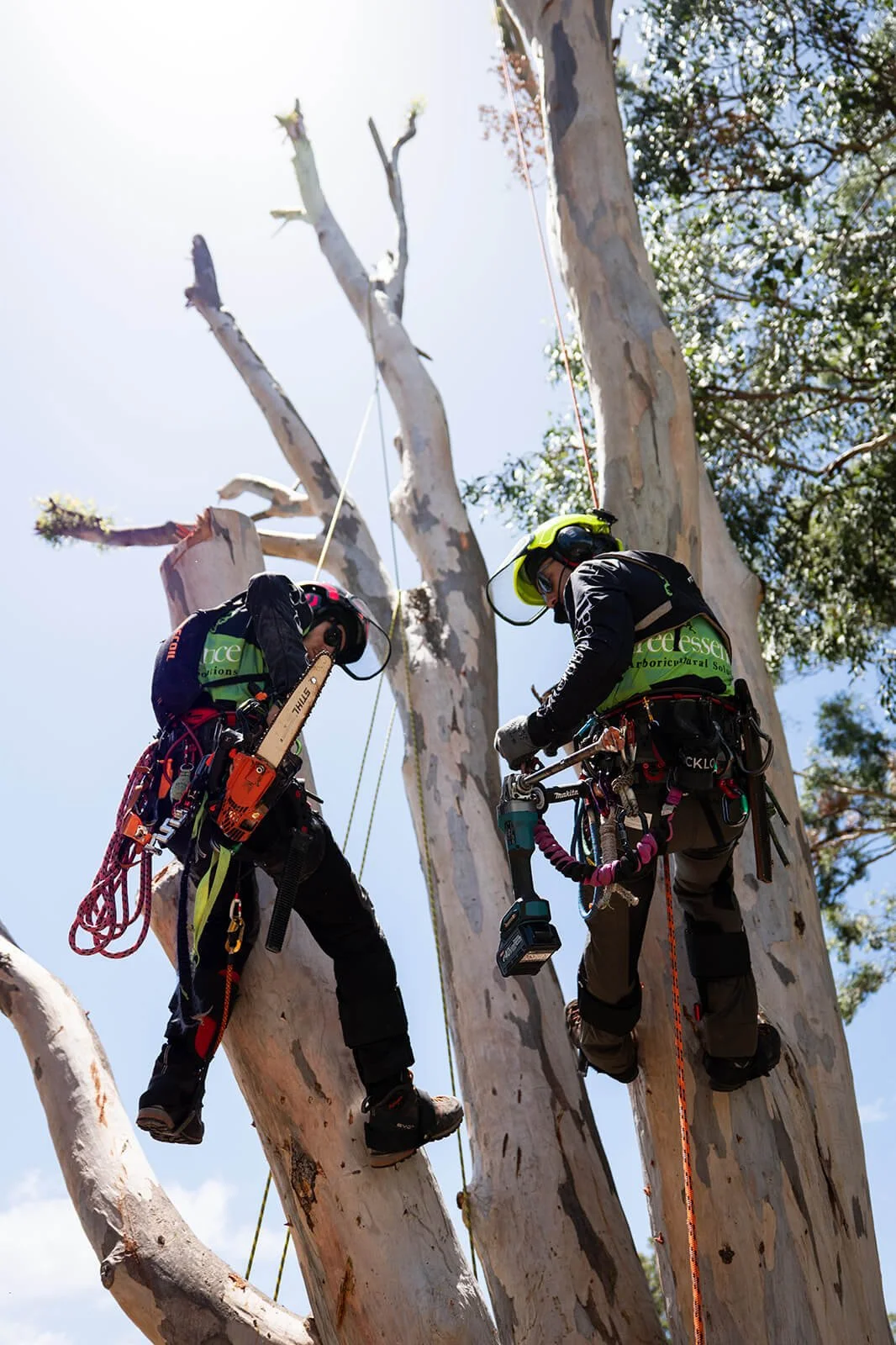
Hollows went directly into the retained eucalyptus stem and major lateral stubs. Where the wood supported it, they were chainsaw-carved into the heartwood of existing stubs, with shaped entrances and internal cavities cut to specification. Where carving into living wood wasn't appropriate, purpose-built hollow boxes in durable timber were attached at the target heights. Every installation was positioned to optimise aspect, drainage, and concealment from predators, then inspected on completion to confirm entrance and depth against the species spec.
Educational value
Sited within a high school, the hollows carry an inherent teaching dimension: a tangible, living demonstration of urban ecology, habitat loss, and conservation practice, directly accessible to students and staff. We provided species information and the rationale behind each hollow for the school to use in environmental education.
[ THE RESULT ]Outcomes
A decade of institutional trust
Over ten years of continuous engagement as the school's sole and trusted arboricultural provider.
Hollow-dependent habitat created
Artificial hollows introduced endemic wildlife habitat that natural processes would take over a century to produce.
Storm damage resolved safely
The 2025 crown failure, a high-tension scenario in an active school, was resolved without incident through methodical planning and skilled execution.
Structural safety maintained
Annual pruning has systematically reduced structural risk across the tree population, year on year.
Environmental education supported
The installation and species information give the school a practical, curriculum-relevant ecological resource.
Storm aesthetic preserved
Corrective cuts respected the tree's natural form while supporting long-term wound closure.
In the client's words
Tree Essence have been looking after our trees for over ten years and the relationship speaks for itself. When the big gum came down in the storm last year it was a stressful situation. We had to close off part of the grounds, and we needed it resolved quickly and safely. The crew handled it professionally, and the work they did afterwards to preserve the tree and put in the wildlife hollows was something we weren't expecting. It turned a difficult situation into something genuinely positive for the school. We wouldn't go anywhere else.
Disclaimer: This case study has been prepared by Tree Essence for general business development and information purposes. Client details are presented with consent. Works described were conducted by qualified personnel in accordance with applicable Australian Standards and industry best practice at the time of engagement. This document does not constitute a formal arborist report or tree management plan.
[ ABOUT ]Tree care grounded in knowledge.
Tree Essence is a family-run arborist business founded in 2013, backed by more than 20 years of hands-on experience. We're AQF Level 5 qualified arborists working across South East Queensland and the Northern Rivers, covering complete tree and palm care for residential, commercial, and rural properties, from consulting and structural pruning through to complex removals, stump grinding, soil amelioration, and specialist habitat creation.
Whatever the job, it comes back to the same thing: do it properly, leave the site clean, and deliver a result you don't have to second guess.
[ CONTACT ]